
Project Overview
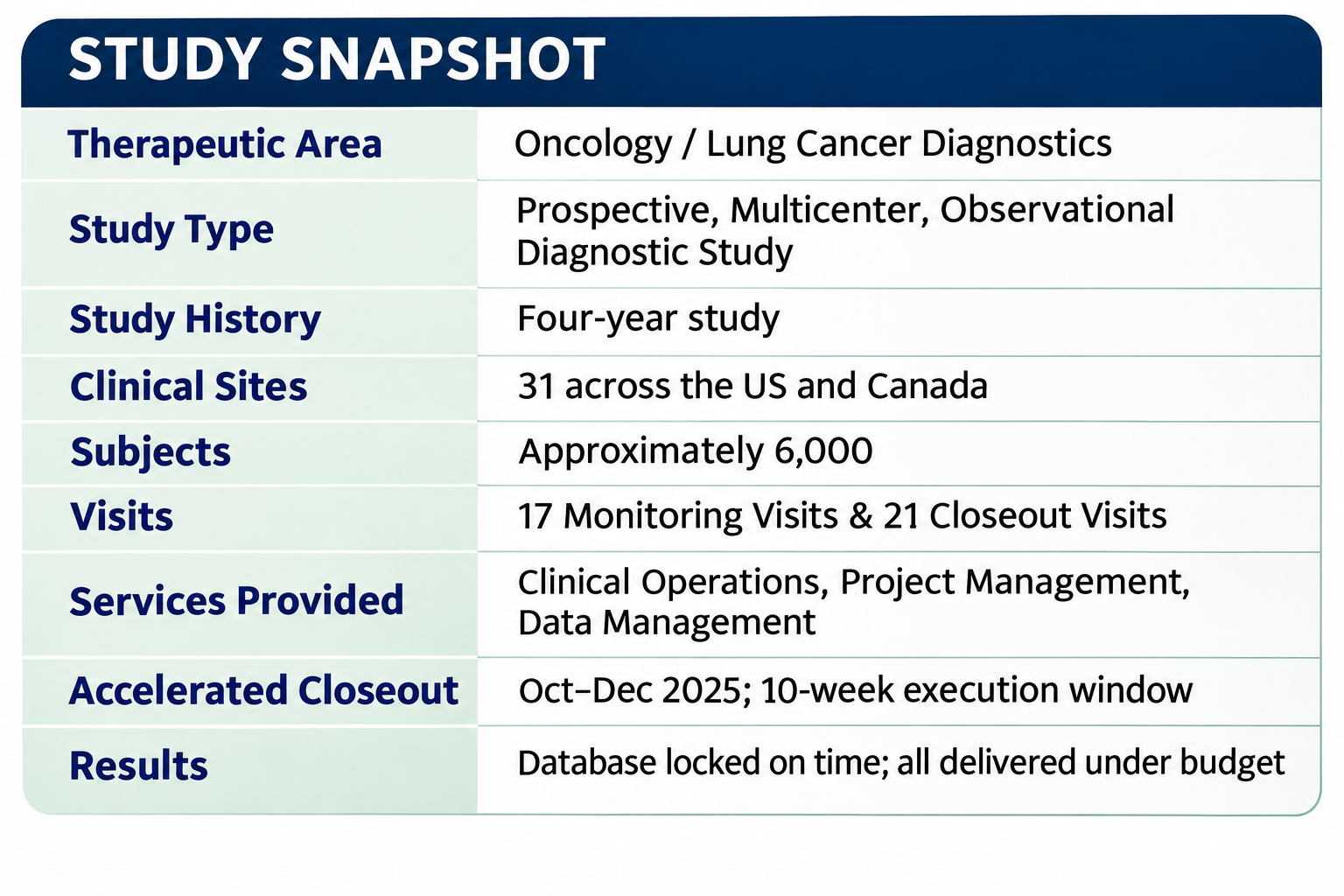
A leading diagnostics company partnered with Beaufort to conduct a prospective, multicenter, observational diagnostic study across the United States and Canada to support the development and validation of a novel blood-based assay for early lung cancer detection.
Beaufort provided clinical operations, project management, and data management services for a study planned to enroll approximately 6,000 subjects at more than 30 sites, including people at high risk for lung cancer and those undergoing evaluation for suspected disease.
The Challenge
A sponsor’s strategic priorities can change faster than a clinical study’s original schedule.
Our study sponsor made a pivotal strategic decision: compress what remained of a planned 12-month follow-up period, close all sites, and lock the database roughly a year ahead of the original schedule.
The scale made the change especially complex: a four-year study spanning 31 sites in the United States and Canada, nearly 6,000 subjects, and years of accumulated data. The remaining work had to be coordinated and completed within 10 weeks:
- Complete all remaining monitoring and closeout visits
- Clean and finalize every subject casebook
- Resolve outstanding queries and support final investigator electronic data capture (EDC) sign-off
- Lock the database on the sponsor’s accelerated timeline
Meeting the accelerated deadline required a coordinated approach across clinical operations, data management, study sites, and sponsor reviewers.
Our Solution
Beaufort mobilized a cross-functional team with the sponsor and developed an integrated closeout plan for the compressed timeline. The priorities were clear: maintain oversight, protect data quality, and keep the interdependent activities moving together.
Monitoring visits, data cleaning, sponsor medical reviews, site queries, and principal investigator (PI) signoffs could not be managed as isolated tasks. The team organized six overlapping workstreams against a single database lock deadline.
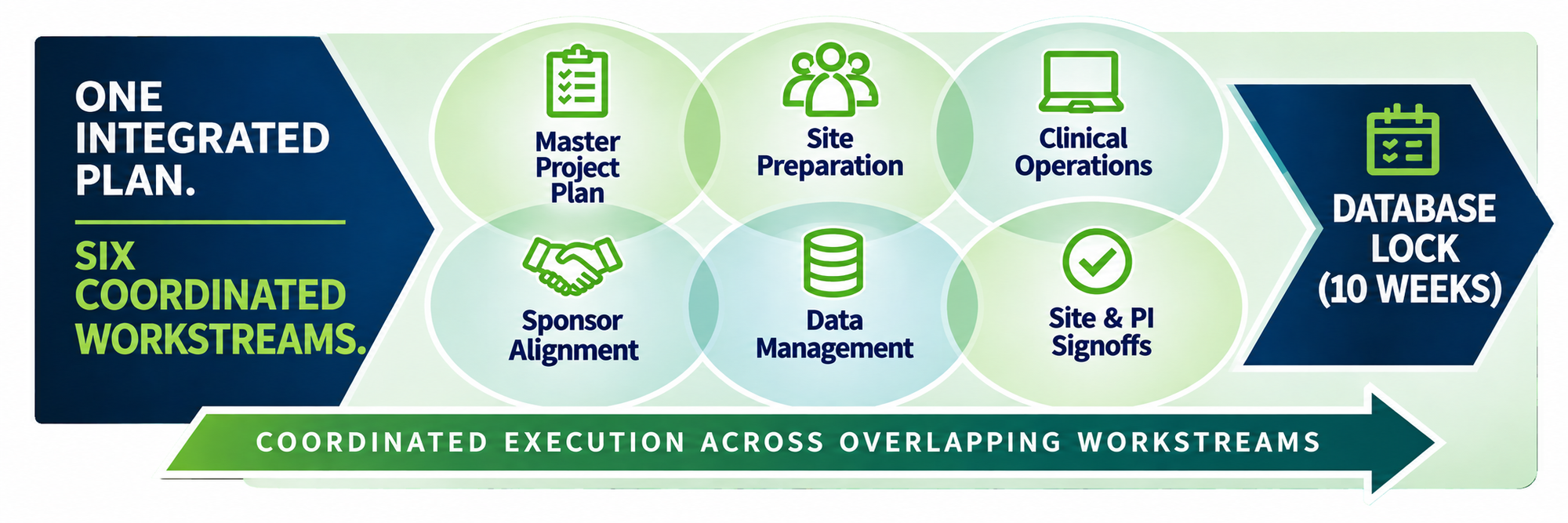
1. Building the Foundation: A Master Project Plan
Beaufort built a master project schedule covering the closeout period. It linked monitoring visits, data cleaning, sponsor review, query resolution, and PI signoffs, with owners, dependencies, and deadlines identified for each activity. The schedule was updated throughout execution as work progressed.
Critical paths showed which activities had to finish before others could proceed. Clinical research associates (CRAs), Data Management, sponsor reviewers, and site teams could see when their work was required and how it affected subsequent milestones.
The project management team tracked milestones and adjusted sequencing as issues arose, keeping the database lock target visible across all workstreams.

- Identifying dependencies early meant a delayed visit, review, or signoff could be addressed before it affected the next workstream.
- A single live schedule enabled cross-functional decisions against the same deadline rather than competing functional timelines.
2. Preparing the Sites in Parallel
Site preparation began while the master schedule was being developed. Sites needed prompt, consistent direction on the shortened follow-up period, revised closeout expectations, and the timing of their remaining responsibilities.
Beaufort coordinated a site communication plan and worked with the sponsor on a protocol clarification letter documenting the revised follow-up period and procedures. The team also coordinated institutional review board (IRB) notifications across applicable sites so the necessary regulatory communications progressed alongside operational preparation.
This centralized coordination gave sites a common set of expectations and a clear route for questions rather than leaving each site to manage the changes independently.
- Consistent instructions reduced uncertainty across 31 sites and limited the risk of work proceeding on different assumptions.
- Advancing regulatory coordination alongside planning helped avoid a separate compliance-related delay once closeout activities began.
3. Coordinating Clinical Operations Down to the Day
The visit schedule covered all 31 sites and included interim monitoring visits (IMVs) and closeout visits (COVs), conducted onsite or remotely according to site needs. Visit timing was coordinated with data cleaning and sponsor medical review windows so information and outstanding issues could move to the next activity promptly.
CRAs completed monitoring reviews, visit reports, and documentation while supporting sites through final closeout. They also performed final Investigator Site File (ISF) and Trial Master File (TMF) essential document reviews at sites active for more than four years.
- Aligning visits with medical review and data cleaning allowed monitoring findings to be acted on while the relevant teams and sites were still engaged.
- Using onsite or remote visits according to site needs focused resources within the limited execution window.
4. Data Management: Cleaned and Locked Under Pressure
Data Management cleaned and prepared approximately 6,000 subject casebooks for database lock, with milestones linked to the monitoring and site closeout schedule. The aim was to progress data work as visits and reviews were completed, rather than accumulate tasks at the end.
CRA source data verification (SDV), sponsor medical review, site data entry, and data cleaning were coordinated so queries could be identified, routed, and resolved throughout the closeout period. Outstanding items remained visible against the database lock timeline.
- Parallel SDV, medical review, data cleaning, and query resolution reduced the amount of unresolved work left for the final weeks.
- Linking data milestones to visits exposed outstanding records early enough for follow-up before database lock.
5. Partnering with Sites and Investigators
Final database lock depended on timely query resolution and investigator electronic data capture (EDC) signoff at all participating sites.
Beaufort worked directly with site teams on outstanding queries, including complex diagnostic cases requiring sponsor medical review. The team accommodated investigator availability, including weekend coordination when necessary, and provided EDC guidance through final PI signoff across all 31 sites.
Expired study supplies were also accounted for, destroyed, and documented according to sponsor requirements.
- Accommodating investigator schedules and providing EDC support addressed a critical dependency: final site-level signoff.
- Direct escalation of complex diagnostic queries to sponsor reviewers helped keep specialized questions from stalling site closure.
6. Sponsor Alignment: Never a Surprise
The sponsor had regular visibility into completed work, upcoming milestones, and decisions requiring its input across the six workstreams.
Sponsor medical review windows were included in the schedule from the outset, allowing review to proceed alongside monitoring, data management, and site closeout instead of becoming a late-stage dependency.
- Scheduling medical review time in advance made sponsor input part of the execution plan, not an unexpected final step.
- Visibility into upcoming decisions allowed sponsor reviews and operational activities to progress in parallel.
The Outcome

In the 10-week execution window, Beaufort and the sponsor and site teams completed the accelerated closeout activities:
- 17 monitoring visits and 21 closeout visits completed across 31 sites in 2 countries (US & Canada)
- Approximately 6,000 subject records cleaned and finalized
- Database locked on time
- All delivered under budget
The sponsor achieved its accelerated database lock objective on schedule and under budget. Feedback from the sponsor and an investigator highlighted the value of coordinated execution and clear communication.
“Thank you Beaufort team for helping reach this key milestone. It was a significant lift and would not have happened without precise coordination and collaboration. We have enjoyed learning and travelling this path together.”
— Sponsor, Study Leadership Team
“Thank you for your excellent communication throughout.”
— Study Site Principal Investigator & KOL
What This Means for Sponsors
Study priorities and timelines can change unexpectedly. When they do, sponsors need a CRO that can translate a new objective into an executable plan without losing control of data quality or critical dependencies.
This engagement illustrates the capabilities Beaufort brings to time-sensitive clinical programs:
- Rapidly mobilizing cross-functional resources around a revised objective
- Building integrated plans that expose critical dependencies
- Coordinating clinical operations, data management, sponsor reviews, and sites
- Maintaining data quality and document readiness under schedule pressure
- Supporting investigators through practical, responsive site engagement
The result was not simply faster closeout. It was a coordinated response that connected clinical operations, data management, sponsors, and investigative sites to deliver against a compressed timeline.